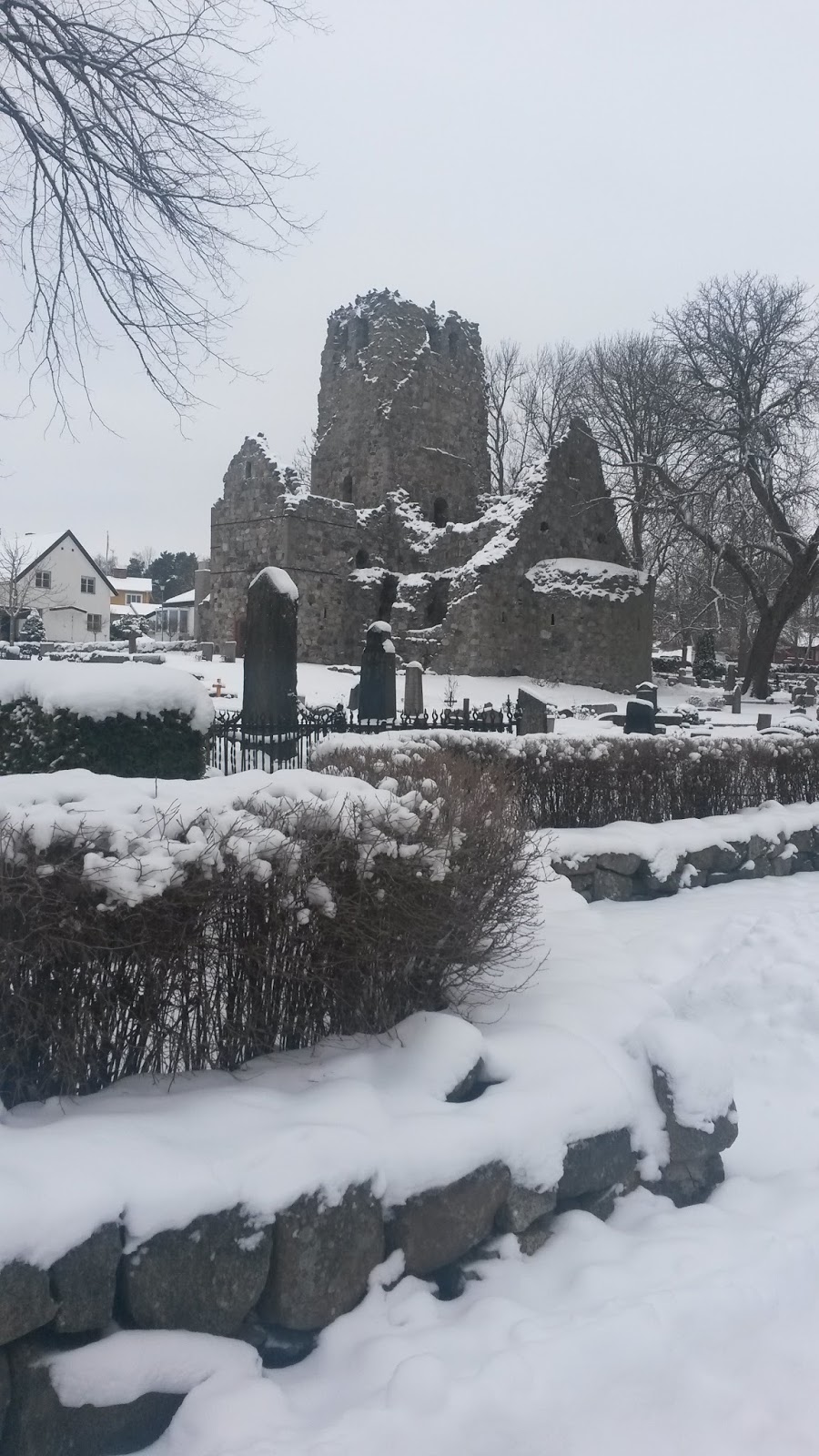
About a week ago the twitter account Svensk Historia tweeted about the Nordic king Erik of Pomerania. I retweeted it saying it always makes me think about the Swedish children's show Salve from 1997. This was read by a host at the Swedish radio music show Klassisk morgon and we started talking about the show and its music. Later that day I was contacted by the producer and they wanted me on the show, so this morning I made my radio debute. It can be heard here but since it is in Swedish and since I have much more to say than I had time for on the show, I thought I would make a blog post about it as well. One of the characters, Katarina Örnfot, has her own post in my My Heroine series. It can be found here and I will try not to repeat myself too much.
I was 12 years old when Salve was first broadcasted and already a history nerd with a massive interest in knights. So this was really the perfect show for me and I started recording it on tape every morning already from the start. A year later, the show was cut down to an eleven episode long TV series which was then made into two VCRs and later on also to a DVD. (And of course I have both and yes, I do still watch the DVD from time to time.)
The plot revolves around Nils Svensson who normally is from 1997. He travels to the Swedish town Kalmar to celebrate the 600 jubliee of the union between all the Nordic countries set up by Danish queen Margaret that normally goes by the name The Kalmar Unionen. He tries to call his mother with his mobile phone, but the display just says 1397. He tries it anyway and gets transported to Kalmar 1397. There he befriends Katarina who is the daughter of a knight and works in the bathing house helping the elderly women Rodwy. Later on he becomes a squire to the rather clumsy knight Rosenstråle. The new 15 year old king, Erik (of Pomerania) is bored in the castle and runs away, out into town and becomes a friend of Nils and Katarina as well. At the end he is officially crowned king.
I cannot over-estimate how much this show has meant to me! It really is historical fiction at its best. It has an overarching frame that is the happenings in Kalmar in 1397 and there also seems to be a structure of what and how they wanted to convey facts. This makes the show take the facts seriously, but is not too serious in how they teach the children making it fun to learn. They had question times where children wrote in questions about the Middle Ages to the show, but most of it was told through the fictive plot. The fact was more showed (or played) into the viewers than taught into them.
Nils is the character through whom the viewers learn and just like me during the time I watched Salve, goes from a rather stereotypical image about knights, to learning a great deal about the period itself. What I find to be one of the best aspects about his character is the fact that he is never seen as stupid like is so often the case with characters the viewers are supposed to learn through in TV shows in general and children's shows in particular. Nils just does not know so much about the Middle Ages when he gets to 1397 because he is from 1997 (The scene before he time travels in the beginning of the first episode also has him imagining a rather stereotypical picture about how he, as a knight, saves a princess from a dragon.).
I have already talked about Katarina, but I cannot stress enough how great she is as a female character. She is not reduced to a steretypical medieval woman or a tomboy who gets to play knight. Neither is she overshadowed by the boys. She is independent, complex and colourful and certainly no damsel in distress.
Based on how popular the show was, I was sad to not see it getting more of a follow up than a shortened version in the autumn the year after. I think it would have been so perfect to make a winter holiday show (or a julkalender) so we could see how the people during the Middle Ages celebrated christmas and handled the colder climate of the season.
I rewatch the show from time to time and even though it is a bit childish from time to time and there are some plotholes, I can overlook its flaws because it is aimed at children and it shows how much fun you can have with real facts. It does still hold up extremely well, 20 years and a master's degree in archaeology later. It had me interested in the Middle Ages as a time period and I am still building on that knowledge in my work as an archaeologist today.
To move forward, one needs to look backwards. That is why i dig downwards.
Visar inlägg med etikett Archaeology. Visa alla inlägg
tisdag 9 maj 2017
Salve. En medeltidssaga
Etiketter:
1397,
14th century,
1997,
Archaeology,
History,
Kalmar union,
Middle Ages,
Salve,
SWE
onsdag 26 april 2017
Vere Gordon Childe - Phryne's archaeologist friend?
Today is the one year anniversary of this blog, my digital baby. And in what better way can I celebrate than write a post about two of my favourite subjects: Phryne Fisher and archaeology. The former was actually the subject of the first real blog post I wrote on this blog, a couple of days after the introductory one.
My view on Phryne has changed a little as I have had more time to think about her as a character, but since I started the books I have also started to gain new knowledge about her, so I think an update is needed. However, this post will not be so much about her character as it will be about a mentioning of a friend of hers in the book version of Blood and Circuses. We do not get to know much about this friend other than it is a man and he is an archaeologist who have been bitten by a lion.
His name is Vere Gordon Childe and he is viewed as one of the most prominent archaeologists of his generation. He was born in Sydney in Australia in 1892, but througout most of his career he lived in Great Britain.
Childe came to study classics at the University of Sydney, before moving to England to study Classical archaeology at the University of Oxford. During his time at Oxford he became a socialist, active in the campaign against the First World War which he saw as coerced by imperialists and which hurt the European workers.
In 1917, he returned to Australia, but due to his socialist engagement, he could not find work in academia and engaged himself in the Australian Labor Party. However, working for them, he became critical towards their politics and took another step to the left on the political scale and engaged himself in the left political movement called Industrial Workers of the World.
Childe emigrated to London again in 1921 where he got work as a librarian at the Royal Anthropological Institute and he also travelled the European continent and brought home the notion of culture from German archaeology to British archaeology. In his book The Danube in Prehistory from 1929, he defined it as:
There are three major theoretical paradigm that usually come up in archaeological publications and classes and Childe sort of has a foot in all three of them. I will here use a lot of -isms that might be tricky to understand if you are not used to an academic language. In those cases, I have linked to the Wikipedia articles about them. If you have any questions about it, please feel free to ask in a comment or on the link post for this entry.
In 1927, he became Abercromby Professor of Archaeology at the University of Edinburgh and took an interest in the Neolithic period on the Orkney Islands. He did some excavations there, the most famous one of the Neolithic village Skara Brae between 1928 and 1930. From 1947 to 1957 he also worked as director of the Institute of Archaeology, London and together with Stuart Piggott and Grahame Clarke he founded The Prehistoric Society.
Upon retiring, he moved home to his native Australia, where he settled down in Blue Mountains for awhile before commiting suicide there in 1957.
Kerry Greenwood uses real life aviator Herbert Hinkler in Ruddy Gore so she is not opposed to the idea of using real life people in a fictional setting. It is, however, very much unclear if Greenwood even knows about Childe (even though he is one of the more influential archaeologists, he might not be known outside of the field). Considering his nationality, where he was active and when, however, I think it is a possibiltiy that Phryne would actually know him.
As I have said before, I am not so found of the comparisson between Phryne and Indiana Jones and to be honest I think the annonced title of the upcoming Miss Fisher film, The Crypt of Tears to fit much better with the latter than the former (which worries me immensely, but I still hope my worries to be unjustified!), if you see Phryne's archaeologist friend as Childe, they do, in fact, have something in common. After all, I have long thought "Indy" might have read too much of Childe's work and he is mentioned by him in Indiana Jones and the Kingdom of the Crystal Skull from 2008.
Edit 27 April 2017: Someone on Facebook made me aware of the fact that the person who was bitten by lion that was referenced in Blood and Circuses was none other than David Livingstone ("I presume.") (1813-1873) and linked to this article about the incident. However, he was not really an archaeologists, mostly considered to be an explorer and missionary.
References
Photo of Childe was borrowed from here.
My view on Phryne has changed a little as I have had more time to think about her as a character, but since I started the books I have also started to gain new knowledge about her, so I think an update is needed. However, this post will not be so much about her character as it will be about a mentioning of a friend of hers in the book version of Blood and Circuses. We do not get to know much about this friend other than it is a man and he is an archaeologist who have been bitten by a lion.
Phryne had been told that the moment before the prey was seized by the predator, it went limp. It ceased to fear or care. An archaeologist friend had talked about the moment when a lion's teeth had closed on his shoulder. Dreamy he had said. The world had ceased to matter. The last mercy, he had said to creatures destined to be dinner was that they went down sweetly and gently to death, reconciled to their place on the menu.As an archaeologist myself, I have been wondering about her archaeologist friend and I think I have found a male archaeologist, contemporary with Phryne, that would fit quite well even if I have no clue if he was ever bitten by a lion.
~ Kerry Greenwood, Blood and Circuses
![]() |
| V. Gordon Childe |
Childe came to study classics at the University of Sydney, before moving to England to study Classical archaeology at the University of Oxford. During his time at Oxford he became a socialist, active in the campaign against the First World War which he saw as coerced by imperialists and which hurt the European workers.
In 1917, he returned to Australia, but due to his socialist engagement, he could not find work in academia and engaged himself in the Australian Labor Party. However, working for them, he became critical towards their politics and took another step to the left on the political scale and engaged himself in the left political movement called Industrial Workers of the World.
Childe emigrated to London again in 1921 where he got work as a librarian at the Royal Anthropological Institute and he also travelled the European continent and brought home the notion of culture from German archaeology to British archaeology. In his book The Danube in Prehistory from 1929, he defined it as:
We find certain types of remains - pots, implements, ornaments, burial rites and house forms - constantly recurring together. Such a complex of associated traits we shall call a "cultural group" or just a "culture". We assume that such a complex is the material expression of what today we would call "a people".How the notion of culture has been used and is still used (both implicitly and explicitly) in archaeology is a subject I love to discuss and I do think Childe's definition still has more relevance for how archaeologists treat the concept today than contemporary archaeologists in general would like to admit. To express my thoughts on the subject would make up at least ten other posts. One thing about his archaeological influence do I need to clarify though.
There are three major theoretical paradigm that usually come up in archaeological publications and classes and Childe sort of has a foot in all three of them. I will here use a lot of -isms that might be tricky to understand if you are not used to an academic language. In those cases, I have linked to the Wikipedia articles about them. If you have any questions about it, please feel free to ask in a comment or on the link post for this entry.
- Chronologically, the first one is usually call Culture-historical Archaeology, Culture Archaeology or simply Traditional -archaeology. This paradigm has a less explicitly defined theoretical base than the later two, but in short the foundation can be found in evolutionism and diffusionism. The notion of culture (pretty much as it was defined by Childe in the quote above) was central to understand the archaeological material. Bruce G Trigger in his book A History of Archaeological Thought (2006) divides up this paradigm between one earlier he calls Evolutionary archaeology and the later Culture-historical archaeology, but most archaeologists do not seem to make the same distinction and the Culture-historical archaeology is very much based on evolutionism also.
- Because of the misuse of Culture-historical Archaeology in Nazi-Germany, archaeology went into a crisis after the Second World War and came out of it by combining a positivistic philosophical theory with a functionalistic view on society and culture into what is normally called Processual Archaeology or New Archaeology. American archaeologist Lewis Binford is normally considered to be the founder, but Childe actually did "experiment" with a functionalistic approach to archaeology before him.
- Postprocessual Archaeology is the newest of the three major theoretical paradigm in archaeology and does not only contain one single theoretical approach but many, for example structuralism, post-structuralism, hermeneutics, gender theory and marxism. The main thing they have in common is their critic of the rigid positivistic approach of New Archaeology and even here you can glimpse the influence from Childe. He turned to marxism to help him in his studies of European prehistory shortly after his first trip to the Soviet Union in 1935.
In 1927, he became Abercromby Professor of Archaeology at the University of Edinburgh and took an interest in the Neolithic period on the Orkney Islands. He did some excavations there, the most famous one of the Neolithic village Skara Brae between 1928 and 1930. From 1947 to 1957 he also worked as director of the Institute of Archaeology, London and together with Stuart Piggott and Grahame Clarke he founded The Prehistoric Society.
Upon retiring, he moved home to his native Australia, where he settled down in Blue Mountains for awhile before commiting suicide there in 1957.
Kerry Greenwood uses real life aviator Herbert Hinkler in Ruddy Gore so she is not opposed to the idea of using real life people in a fictional setting. It is, however, very much unclear if Greenwood even knows about Childe (even though he is one of the more influential archaeologists, he might not be known outside of the field). Considering his nationality, where he was active and when, however, I think it is a possibiltiy that Phryne would actually know him.
As I have said before, I am not so found of the comparisson between Phryne and Indiana Jones and to be honest I think the annonced title of the upcoming Miss Fisher film, The Crypt of Tears to fit much better with the latter than the former (which worries me immensely, but I still hope my worries to be unjustified!), if you see Phryne's archaeologist friend as Childe, they do, in fact, have something in common. After all, I have long thought "Indy" might have read too much of Childe's work and he is mentioned by him in Indiana Jones and the Kingdom of the Crystal Skull from 2008.
Edit 27 April 2017: Someone on Facebook made me aware of the fact that the person who was bitten by lion that was referenced in Blood and Circuses was none other than David Livingstone ("I presume.") (1813-1873) and linked to this article about the incident. However, he was not really an archaeologists, mostly considered to be an explorer and missionary.
References
- Bjørnar Olsen 2003. Från ting till text. Teoretiska perspektiv i arkeologisk forskning. svensk översättning: Sven-Erik Torhell, Lund
- Bruce G. Trigger 2006. A History of Archaeological Thought, Cambridge
- https://en.wikipedia.org/wiki/V._Gordon_Childe
Photo of Childe was borrowed from here.
torsdag 23 mars 2017
Tutankhamun. The tomb and the Treasure
Carnarvon: "Can you see anything?"On Tuesday, I visited the travelling exhibition about the Egyptian pharaoh Tutankhamun in Stockholm. It was all made up of replicas and as someone working in the heritage sector, I think it is a great idea. Not everyone has the money to travel to Egypt, but is still in love with its history and the amazing artefacts I think we can safely say that everyone has seen at least once in a book or on TV.
Carter: "Yes, wonderful things!"
I really enjoyed the exhibition. They really had tried to put all the artefacts into a context, which was a pleasant surprise. I thought it was going to be, like it often is with travelling exhibitions like this. Especially when it comes to really famous objects. But it is important for the understanding of the objects to have a context to place them in.
The objects are of course amazing in themselves, but there is much to be learned from them as well. Ancient Egypt is really a very different culture (even from today's Egypt) and to create an understanding of it, we much put all those treasures into a context to really understand it.
Even though I have had an interest in Ancient Egypt for years (I have also studied Egyptology at the university for a year.), I still think I have lots to learn. This also became pretty obvious at the exhibition. For the first time, I really understood what a so called corn Osiris looked like. (See picture bellow.)
![]() |
| Corn Osiris |
I missed a mummy, even though I totally understand why it was not possible to have one. The had a wall explaining research that has been done on the mummy and different theories of how he might have died. Underneath had they placed a table with a picture of the mummy. This was actually quite a good way to sudstitute, even though I do prefer real mummies. (Yes, I am somewhat obsessed with death and burials!)
While you walked around among the artefacts after this view of the tomb itself you could choose if you wanted to listen to more or just walk around and I was really amazed by it all. It had me thinking a lot. For example how the outer chapel of the coffins were built. The replica was placed on a podium the size of the burial chamber and the builders can not have had much space to move around as they built it for sure. And how do you actually move coffins of solid gold that weigh over 1 000 kilos?! Because I refuse to say aliens, I am going for a lot of block and tackles and hard working workers (No, Ancient Egypt did not keep slaves! In fact the first known strike in history is of Egyptian tomb workers who fought for higher salary.).
To sum it all up: I loved the exhibition. More should be made like this.
Etiketter:
Ancient Egypt,
Archaeology,
Exhibitions,
History,
Howard Carter (1874-1939),
Tutankhamun
onsdag 18 januari 2017
Female Archaeologists - Gertrude Caton-Thompson
![]() |
| Gertrude Caton-Thompson |
Dwelling into the research history of archaeology, one actually find rather a lot of different women who worked on excavations with or without men (mainly their husbands). It seems to have been particularly easy for American, British and French women to do archaeological work in the colonies. They also seem to have had it easier if they had worked with something that their contemporary society (late 19th and early 20th century) thought of as fitting for a woman. There are quite a lot of nurses among them for example.
Many of these female archaeologists worked in their shadows of their husbands and have become marginalised in the research history because their texts were published in their husbands's names. There were also quite a few women working in archieves and museum storehouses who's work never really classified as archaeology wherefore they are never mentioned in research historical overviews. Quite a few of them, however, did have an obituary. Not least the archaeologist I intend to devote the rest of this post to. Her name was Gertrude Caton-Thompson and she was born in London in 1888. Her interest in archaeology was founded when she visited Egypt together with her mother in 1911 and afterwards also visited Sarah Paterson's on Ancient Greece at the British Museum. She inherited money in 1912 which made her financially independent and studied both a Cambride and University College London from 1921 onwards. Among her teachers were Margaret Murray, Dorothea Bate and William Matthew Flinders Petrie. She participated in quite a few excavations in Egypt during the 1920's. Not least in the Faiyum oasis with geologist Elinor Wight Gardner in 1925.
![]() |
| Part of Great Zimbabwe |
![]() |
| Aerial view of Great Zimbabwe |
Therefore the association sent Gertrude in 1929. She did, however, confirm Randall-MacIver's theory of an African origin. Not least since she could find similar objects being made among contemporary native craftsmen. For this she became very impopular among the same crowd as Randall-MacIver's but she stood her ground, publishing her results in 1931. She was not totally unbiased though. After having established that Great Zimbabwe had African origin, she talks about the remains in a rather degrading way, but there is no way to deny that her research was important. She used stratigraphical methods and artefact chronology to date the site to the Middle Ages. Dates that have actually been confirmed by carbon dating today.
Gertrude died in 1985.
References:
- Arwill-Nordbladh, Elisabeth 2003. Genusforskning inom arkeologin, Högskoleverket, Stockholm
- Palmer, Douglas & Bahn Paul G. & Tyldesley, Joyce 2006. Arkeologins största upptäckter, Swedish translation by Kjell Waltman, Historiska media, Kina
- Renfrew, Colin & Bahn, Paul 2012. Archaeology. Theories, Methods and Practice, Thames and Hudson, London
- Trigger, Bruce G. 2006. A History of Archaeological Thought, Cambridge University Press, Cambridge
Etiketter:
Africa,
Archaeology,
Female Archaeologists,
Gertrude Caton-Thompson (1888-1985),
Great Zimbabwe,
UK,
ZWE
lördag 14 januari 2017
Treasures of Ancient Egypt
"We cannot find our future if we forget our past."I have been watching this three part documentary called Treasures of Ancient Egypt where art lover Alastair Sooke discover ancient Egypt through 30 art pieces and what he finds is very intriguing.
~ Alaa Awad, modern Egyptian artist
At a first glance, ancient Egyptian art seems schematic and static and everything is supposed to be the same over thousands and thousands of years. Sooke, however, finds that there are a lot of things that interupts the static and schematic pictures, making them full of life. Some art pieces also goes more or less against the schematic style. I loved the so called ostraka Sooke finds in the worker's village Deir-el-Medina. They are much more free-styled and a lot of them are also parodies on the official style.
As someone who has studied colonialism/imperialism/cultural meating for awhile I do not really see it as strange that the invaders in Egypt after the New Kingdom tried portraying themselves as Egyptian, but also incorporating their own style, creating a hybrid. This is something I have tackled before, here and here but it might be time for a recap. To me, we are thinking too biologically about the concept of culture, one of the many things we have not been able to shake from modern imperialism of the last two centuries. It is extremely seldom that invaders go in and force their own culture on the colonized groups. This is an idea sprung from imperialism during the last two centuries and only one form out of many types of colonialism. Everyone of them were about power, but not everyone of them has been as devestating as imperialism during the last 200 years. Sooke says that maybe the Greek dynasty, the Ptolemies were not so powerful so they could introduce Greek culture into Egypt. I, however, would rather say that they were smart. They seem to have a much better understanding of cultures and how they interact than we do today. By using history and the old expressions of power in Egypt, they legitimized their right to rule over the Egyptians. They sought to build on the sense of eternity and stability presented in ancient Egyptian art, but like all cultures do as they adopt new traits, they interpreted it through their own cultural logic. This is why we actually can see some Greek influences in Egyptian art from this time. It really is like Egyptian artist Alaa Awad said to Sooke and which I qouted in the beginning. We all must look to the history to find our future.
Picture was borrowed here.
Etiketter:
Ancient Egypt,
Archaeology,
Art,
Cultures,
Documentary,
EGY,
Egyptology,
History,
TV,
UK
tisdag 3 januari 2017
Terry Hayes - I am Pilgrim
I cannot recall anytime when I have been as confused by what to feel about a book as I was about I am Pilgrim by Terry Hayes (I read the Swedish translation by Örjan Sjögren.).
The plot surrounds "the Pilgrim". He is a super rich white American secret agent traveling the world catching bad guys. His "archenemy" is an islamist that he has to capture. Both of their backgrounds are explored in detail. I mean, there are even backstories to the backstories!
I had a teacher once who had worked as a taxi driver. He sometimes told us anecdots about the clients he had had during those days and what he had learned about people from them. One of them, reagarding male and female conversation did I find particularly interesting for a description of the writing in I am Pilgrim.
My teacher said that, based on conversations he had overheard from the backseat of the taxi as he was driving people around he could decipher two types of conversations. One could generally be ascribed to men and the other to women. The male one can be seen as a pretty straight line (one topic). It might from time to time deviate from it, but always got back to that first line pretty soon afterwards. The female conversation however is rather unstructured, meaning women tend to jump much more between topics and might also be discussing many topics together at the same time. If ever they do go back to the original topic, it can take quite awhile, when every other subject has been discussed. Since he told my class this, I have thought about it watching others have conversations and often find it to be true. What is interesting about I am Pilgrim is that it is written rather much like a female conversation. There are a lot of different anecdots from different times in the main character and his archenemy's lives, not always told in chronological order and after a while you start wondering when it is ever going to return to the bathroom with the dead girl that opens up the entire book.
One of the back stories within the backstories turned out to be the most interesting part of the book for me. It is when the Pilgrim tells us a story of how he and his adoptive father visited a lesser known concentration camp, Natzweider-Struthof, on the border between France and Germany in his youth. The Pilgrim talks about how emotional he got by a photo of a mother and her children as they walk to the gas chambers and I think we can all relate to that. Photos of the Holocast tend to leave a sense of horror and emotions in most of us. As an archaeologist however, I find his adoptive father's reaction to the pile of everyday items even more intriguing. The adoptive father says something about he never knowing how powerful simple things can be (Because I read the Swedish translation of the book I won't quote it because as can be seen by Google Translate Sings on Youtube, translation back to the original language might not work so well.).
Archaeology is all about researching how people are interaction with materialities. We have always interacted through them and we continue to do so. They are history in physical form. They make us remember. They make us reflect. They make us feel emotions. They can even make history more human and close! In a word that turns digital and immaterial more and more by the minute, I think it is important that materialities are used to keep us grounded in "the real world". I am not against digitalization. I think there are a lot of benefits. However it happens too quickly and unreflectively. I rarely blog about my profession, but this is something I think even non-archaeologists should be aware of and reflect upon from time to time.
But back to I am Pilgrim. Even though it got me hooked, I still cannot shake the fact that it is very much a tale about a white man written by a white man. Even the title indicates as much! It is good that Hayes tries to make him more "human" by having him react to a photo of Holocaust victims and he says he has no problems with female being the hitmen and he shows sympathy for the Romani people (Because I read the Swedish version I have no idea if the more degrading term for them was used in the original book as it was in the Swedish.). Hayes also give the islamistic sort of "archenemy" a (too) well-described backstory with a thoroughly explored motivation for going all extremist. It felt refreshing against the all too normal Hollywood "because they are evil"-approach. However as he describes himself as a super rich, super intelligent, super competent super secret super agent who makes a lot of mistakes (seriously every other chapter ends with him telling about a new one), but who people still think is the best at his job and who is the youngest boss the super secret super agent bureau has ever heard of, I cannot help thinking he would be completely dismissed as a Mary Sue character had he been a woman.
The plot surrounds "the Pilgrim". He is a super rich white American secret agent traveling the world catching bad guys. His "archenemy" is an islamist that he has to capture. Both of their backgrounds are explored in detail. I mean, there are even backstories to the backstories!
I had a teacher once who had worked as a taxi driver. He sometimes told us anecdots about the clients he had had during those days and what he had learned about people from them. One of them, reagarding male and female conversation did I find particularly interesting for a description of the writing in I am Pilgrim.
My teacher said that, based on conversations he had overheard from the backseat of the taxi as he was driving people around he could decipher two types of conversations. One could generally be ascribed to men and the other to women. The male one can be seen as a pretty straight line (one topic). It might from time to time deviate from it, but always got back to that first line pretty soon afterwards. The female conversation however is rather unstructured, meaning women tend to jump much more between topics and might also be discussing many topics together at the same time. If ever they do go back to the original topic, it can take quite awhile, when every other subject has been discussed. Since he told my class this, I have thought about it watching others have conversations and often find it to be true. What is interesting about I am Pilgrim is that it is written rather much like a female conversation. There are a lot of different anecdots from different times in the main character and his archenemy's lives, not always told in chronological order and after a while you start wondering when it is ever going to return to the bathroom with the dead girl that opens up the entire book.
One of the back stories within the backstories turned out to be the most interesting part of the book for me. It is when the Pilgrim tells us a story of how he and his adoptive father visited a lesser known concentration camp, Natzweider-Struthof, on the border between France and Germany in his youth. The Pilgrim talks about how emotional he got by a photo of a mother and her children as they walk to the gas chambers and I think we can all relate to that. Photos of the Holocast tend to leave a sense of horror and emotions in most of us. As an archaeologist however, I find his adoptive father's reaction to the pile of everyday items even more intriguing. The adoptive father says something about he never knowing how powerful simple things can be (Because I read the Swedish translation of the book I won't quote it because as can be seen by Google Translate Sings on Youtube, translation back to the original language might not work so well.).
Archaeology is all about researching how people are interaction with materialities. We have always interacted through them and we continue to do so. They are history in physical form. They make us remember. They make us reflect. They make us feel emotions. They can even make history more human and close! In a word that turns digital and immaterial more and more by the minute, I think it is important that materialities are used to keep us grounded in "the real world". I am not against digitalization. I think there are a lot of benefits. However it happens too quickly and unreflectively. I rarely blog about my profession, but this is something I think even non-archaeologists should be aware of and reflect upon from time to time.
But back to I am Pilgrim. Even though it got me hooked, I still cannot shake the fact that it is very much a tale about a white man written by a white man. Even the title indicates as much! It is good that Hayes tries to make him more "human" by having him react to a photo of Holocaust victims and he says he has no problems with female being the hitmen and he shows sympathy for the Romani people (Because I read the Swedish version I have no idea if the more degrading term for them was used in the original book as it was in the Swedish.). Hayes also give the islamistic sort of "archenemy" a (too) well-described backstory with a thoroughly explored motivation for going all extremist. It felt refreshing against the all too normal Hollywood "because they are evil"-approach. However as he describes himself as a super rich, super intelligent, super competent super secret super agent who makes a lot of mistakes (seriously every other chapter ends with him telling about a new one), but who people still think is the best at his job and who is the youngest boss the super secret super agent bureau has ever heard of, I cannot help thinking he would be completely dismissed as a Mary Sue character had he been a woman.
Etiketter:
2013,
Archaeology,
I am Pilgrim,
Materialities,
Nathan Page's book club,
Terry Hayes
lördag 15 oktober 2016
International Day of Archaeology
Apparently it is International Day of Archaeology today. I had absolutely no idea until I saw it around the Internet. I have to admit I have a lot of questions about this holiday. How did it come about? How are you supposed to celebrate it? Are you supposed to have cake?!
I have celebrated it by handing in a grad school application. I do not know if I have any chance at getting it, but I hope to at least get some response on my project plan this time. The picture to the right show some of the books I have been using.
As might have become evident by many of the entries in this blog, my greatest interests are Vikings, cultures and colonialism. So of course I am trying to mix them together into one research project, trying to discuss how the Vikings viewed the concept and how the research tradition being caught up in nationalism of the 19th century having applied to the period making it more of a Viking version of the 19th centry than anything.
I have celebrated it by handing in a grad school application. I do not know if I have any chance at getting it, but I hope to at least get some response on my project plan this time. The picture to the right show some of the books I have been using.
As might have become evident by many of the entries in this blog, my greatest interests are Vikings, cultures and colonialism. So of course I am trying to mix them together into one research project, trying to discuss how the Vikings viewed the concept and how the research tradition being caught up in nationalism of the 19th century having applied to the period making it more of a Viking version of the 19th centry than anything.
Etiketter:
Archaeology,
International Day of Archaeology,
My own research
måndag 10 oktober 2016
Anna Lihammer - Medan mörkret faller
Today is my birthday and even though I have other things I really need to do, I spent all morning reading.
I have long thought about reading the mystery books by Anna Lihammer because people say that they are good and Medan mörkret faller (While the darkness falls) was elected best mystery debute of 2014. Beside, Anna is a colleague of mine, being a Swedish archaeologist and Medan mörkret faller is set in 1934.
The time setting in the 1930's made me draw lots of parallels to the books and TV series about the Honourable Phryne Fisher. Mostly the episode The Blood of Juana the Mad, because Lihammer's book is about somewhat the same themes and is also about a gruesome murders among medical staff in a university milieu.
The story is a reaction to Lihammer gaining the knowledge about skull collections in Sweden, but also the fact that in 1934 the Swedish parliament voted for a law about compulsory sterilization of people who weren't considered fit enough for "carrying on the Swedish race". The law remained in place until 1976.
I really enjoy this book and I think it is very evident that Lihammer is an archaeologist. She dwells into the time period, making it come alive just like in the books/TV series about Phryne Fisher.
She also talks about how human bodies (both alive and dead) are treated like objects. Of course this is something archaeology deals with all the time and which I think we need to discuss more than we do.
I have long thought about reading the mystery books by Anna Lihammer because people say that they are good and Medan mörkret faller (While the darkness falls) was elected best mystery debute of 2014. Beside, Anna is a colleague of mine, being a Swedish archaeologist and Medan mörkret faller is set in 1934.
The time setting in the 1930's made me draw lots of parallels to the books and TV series about the Honourable Phryne Fisher. Mostly the episode The Blood of Juana the Mad, because Lihammer's book is about somewhat the same themes and is also about a gruesome murders among medical staff in a university milieu.
The story is a reaction to Lihammer gaining the knowledge about skull collections in Sweden, but also the fact that in 1934 the Swedish parliament voted for a law about compulsory sterilization of people who weren't considered fit enough for "carrying on the Swedish race". The law remained in place until 1976.
She also talks about how human bodies (both alive and dead) are treated like objects. Of course this is something archaeology deals with all the time and which I think we need to discuss more than we do.
Det var inte första gången någon reagerade på hans utseende, det hände ofta och det var inte alltid negativt. Men intresset brukade inte så tydligt göra honom till ett samlingsvärt objekt, uppmätt och liksom klart för sortering (Not for the first time, did someone react to his appearance, it happend often and not always in a negative way. But the interest seldom so obviously made him into a collectable, measured and ready to be sorted.)
The book also reminded me of an episode of History Cold Case. It also dealt with human bodies as collectables and study objects and discovered a story about a child who probably was killed because of human bodies being coveted for the study of medicine. It is a terrible, dark side to the more recent past of Sweden and many other Western countries. Evil done in the name of science. One might wonder how people can become so cold blooded, but I do not think it is so strange somehow. It all has to do with who you define as human.~ Anna Lihammer, Medan mörkret faller
Den nya tiden. Den moderna tiden. Han undrade hur många av besökarna som skulle passa in där. Och vad som skulle hända med dem som inte gjorde det, för visioner brukade förr eller senare leda till att de som inte kunde uppfylla dem sorterades bort. Ju storslagnare visioner, desto hårdare sortering. (The new time. The modern time. He wondered how many of the visitors would fit in there. And what would happen to the ones who did not, because visions sooner or later used to led to the ones who could not fulfill them being sorted out. Greater visions led to harder sorting)
The Swedish law of compulsory sterilization is actually one expression of this sorting, scientific racism another and Lihammer builds up the book plot surrounding this question of who are defined as humans. It is dark and gruesome and really horrible. A dark past that is poking on the present still.~ Anna Lihammer, Medan mörkret faller
Etiketter:
2014,
20th century,
Anatomical collections,
Anna Lihammer,
Archaeology,
Books,
Crime,
History Cold Case,
Medan mörkret faller,
Scientific racism,
SWE
måndag 19 september 2016
Ötzi, the Iceman
![]() |
| Ötzi |
This find was actually one of the reasons for why I chose my profession. I was seven at the time they found him and he was one of my first real nerdy subjects. The finding of him was led to a massive interest from the media and one of my school teacher brought lots of them with her and we looked at the pictures and read all about him and talked about him and the Stone Age. He really made history come to life from me.
He seemed to have had a hard life, his body having many healed fractures. Isotope analysis of his tooth showed that he came from there area of either Eisacktal or Pustertal. Among other things he carried a copper axe and an unfinished bow. His tattoos have been discussed a lot. I, myself wait for the day someone comes up with the idea that he made them while he was drunk...
Picture from Wikipedia.
Etiketter:
1991,
Archaeology,
AUT,
Chalcolithic,
ITA,
Mummies,
the Ice Man,
Ötzi
onsdag 14 september 2016
Some thoughts about Cultural Heritage
He who controls the past controls the future. He who controls the present controls the past.~ George Orwell, 1984
![]() |
| Monument of the Vendel Age boat burials in Vendel, Uppland |
![]() |
| Gamla Uppsala, Uppland |
![]() |
| Stern of the Vasa ship |
I have talked about my view on the term culture in many previous entries to this blog (most notably in this and this) and I don't intend to repeat myself too much in this one. However I want to state that my definition of the term culture is that it is entirely a social construction. It is never finished and it is under continous negotiations. It has all to do with what is socially acceptable in different social contexts.
![]() |
| St Olof's church ruin, Sigtuna, Uppland |
In my entry about the Stone Age I talked about how European encounters with other social groups through the Western colonialization of the last few centuries pretty much created the whole time period. Analogies was used to the contemporary "hunter-gatherer" societies to show that they belonged to a stage of development the European countries had left behind a long time ago. Just like the Stone Age was created based on a focus of difference, so was the Nation state created through focusing of what it was not.
![]() |
| Rune stone U161, Risbyle Uppland |
However, this perspective was very excluding. It excluded certain groups of people (in Sweden for example the Samis) but also parts of the past that was not glorious at all. For example, the Age of the Swedish Empire (Stormaktstiden) during the 17th and the 18th centuries was portrayed as bellicose, heroic and not least masculine. One did not talk about the rather catastrophic results of those war and values: Sweden itself was about to destruct due to the wars and a lot of people, both in Sweden and abroad, suffered greatly because of them. (Sweden would totally have been destroyed if it had not been for the women, but that is a story for another time.)
This is not so much a thing of the past either. We still tend to view our history through "romantic nationalistic glasses". To take the example of the Age of the Swedish Empire again, the Swedish newspaper Expressen as late as last year had a magazine about Sweden's "bloody history" in which one could read:
"Karl XII ärvde en stormakt från pappa Karl XI och de andra lyckosamma regenterna från 1600-talets krigiska epok." (Karl XII inherited a super power from his father Karl XI and the other successful rulers of the bellicose epoch of the 17th century.)I didn't really know what to think about this quote and the fact that they this summer had a similar magazine devoted to the Swedish war kings made me realise even more how important investments in public outreach really is.
![]() |
| Microlithic flint blade, dated to the Mesolithic that I found at Kanaljorden, Motala, Östergötland in 2013 |
There is another example, which might sound even more strange and I realised just how strange it is that we emphasize it because I went to a show by the American ventriloquist Jeff Dunham in Copenhagen a couple of years ago.
He came directly from Stockholm where he had visited one of the major tourist attraction of the Swedish capital and by far the most visited museum of the country: the Vasa museum.
![]() |
| The DC-3, Flygvapenmuseum, Linköping |
Why do we need a cultural heritage then? Well, I think mostly because it seems like a basic instinct inside of us all to seek our history, but also to be able to orientate ourself in time as well as in place wherever we are really. The important thing is that it needs to be including. We need to focus more on what makes our own cultural heritage similar to anyone else's than differences.
Last, but not least I want to show you a photo I found on Tumblr called “Globalization is beautiful sometimes”. It was taken in the Stockholm underground by Ninni Andersson in 2015.
PS. Om Ninni Andersson eller någon av flickorna på bilden ser detta: Det är en underbar bild! Jag hoppas det är okej att jag lånade den. Tack!
Etiketter:
Archaeology,
Contract Archaeology,
Cultural Heritage,
Cultures,
History,
Humanism
lördag 3 september 2016
About chess - or the other inspiration for my view on culture
Not much is known
Of early days of chess
Beyond a fairly vague report
That fifteen hundred years ago
Two princes fought, though brothers
For a Hindu throne
~ Chess, Story of Chess
![]() |
| The Eddan Queen Photo: Historiska museet i Lund |
My grandfather taught me to play chess when I was five. Even though the blog post about the Eddan Queen is very imformative, there are some problems with it. For example it uses a direct translation to Swedish of the English names of the pieces and I will tell you why I find this problematic later on in this post, but first som back story.
Chess originated in India and is said to have been spread to Europe via the Arabs in the early Middle Ages. The oldest known written sources of the game and its rules is Versus de scachis dating to c. AD 1000. The blog post about the Eddan Queen says that it probably came to Scandinavia during the 12th century. However, as always with written sources, I think there are reasons to be cautious saying this dates the first use of the game in either Europe or Scandinavia. It might have been used for quite some time before that, just that no one had thought about writing it all down.
![]() |
| Part of the Lewis chess set. Photo: National Museums Scotland |
Like so often when different cultures interact and pick something up from one another, changes need to be made to accommodate the new social context. This also happened to the chess set. In the blog post about the Eddan Queen, it was explained that the army of the Indian and Arabic game turned into representations of the social classes in the European feudalistic society. I, myself, would actually not say that that was really the case.
The Medieval army of the European countries actually did consist of both kings, pawns, knights and bishops and sometimes even women (like queens). However, there were ceveral changes in the pieces collection anyway. The king kept his title, but his advisor, the vizier of the Indian/Arabic version turned into a queen. In Swedish she is normally known as Dam (direct translation: Lady). The battle elephant turned into a bishop in the English version of the game. In Sweden those same pieces are known as Löpare (direct translation: Runner) and the horses where never turned into knights as in the English version. The name normally used in the Swedish version is an older term for horse: Springare. In the Indian/Arabic chess, there were also two wagons that became castles in English and Torn (towers) in Swedish and also the foot soldiers turned into pawns (This is actually the only piece that can be directly translated in Swedish: Bönder.).
Why is this so important to me? Because chess is actually an excellent way to see how far Christianity had spread throughout Europe and which of the "classical social classes" of the Medieval period that had been established at the time the game was introduced.
![]() |
| More stilistic chess pieces |
The rules of the games also changed when it came to Europe, giving the new queen a much more active role in the games. Today she is the most valuable and piece.
But how about the Arabs? Did they find a need to change the game from its Indian roots? Yes, they did. The older, more naturalistic pieces contradicted the Quran's prohibition of portraying humans and animals. Because of this, the game pieces were transformed to more abstract versions. Today you can find them both while looking for chess sets.
![]() |
| King in a set of game pieces for Hnefatafl from burial BJ750, Hemlanden Birka, Björkö, Mälaren, Sweden Photo by SHM 2001-09-26 |
Pictures were borrowed from here, here and here and here.
Etiketter:
12th century,
Arabs,
Archaeology,
Board Games,
Chess,
Cultures,
History,
Hnefatafl,
India,
Middle Ages,
SWE,
UK,
Vikings,
Östergötland
söndag 17 juli 2016
My Heroines: Katarina Örnfot
A union of the Nordic countries called the Kalmar union, was established by Queen Margareta in 1397 and in 1997 there was therefore a big jubliee in the Swedish town Kalmar (which gave its name to the union.
Swedish Television (SVT) has usually a special show for children in the mornings during the summer holidays. In 1997 the plot of that show told the story about Nils Svensson who has a great interest in knights and travels to Kalmar in 1997 to take part of the jubilee and through his mobile phone ends up in Kalmar 1397. There he befriends Erik of Pomerania who was crowned king in the last episode and the rather clumsy knight Riddare Rosenstråle. His best friend, however, is Katarina Örnfot (Anna Rydgren).
Katarina is the daughter of the knight Bengt Örnfot and most of her other family died from the plague. She has had a brother named Karl too. He was a squire. Bengt was injured in the war against the, so called, mecklenburgarna* and cannot fulfil his duties as a knight. Because of this Karl is given the task of representing him so the family can keep their position in the nobility. The big problem is that Karl died in battle with mecklenburgarna. This is kept a secret between Katarina and her father to not jeopardise their social position. Also because of this, Katarina takes on the role as squire and becomes the best rider in all of Kalmar. The reason why it has to be kept a secret is because women were not allowed to become knights, something they also clearify many times in the show. However Katarina's story might not have been so fictive as you might have thought.
The general picture of the woman in the Middle Ages have changed a lot in recent years and Katarina seems to reflect this. The portrayal of the woman in the Middle Ages was actually one of the main problems I had with SVT:s julkalender (christmas calender) Tusen år till julafton (1000 years to christmas eve) last year (2015).
Tusen år till julafton depicted the medieval woman as precluded from society, trapped in some castle all the time and boring in general. A picture that has been questioned a lot by researcher of the last decades. Katarina is a strong contrast to this picture. She is actually quite the opposite: colourful and independent. She takes an active role in her society and she is never overshadowed by her male companions in the show.
I like the plotpoint of her being a squire and later dubbed as a knight in her own name. I can also oversee with the anachronism of this because they explained that women were not allowed to become knights so much. It is a perfect example of how you, inside the frame of a fictive historical narrative can problematize an issue from the time period in which the story takes place. It legitimize the liberties taken by the people behind the story. This is one of the biggest issues (besides showing an outdated picture of the medieval woman) that I have with Tusen år till julafton as well. In the episode that portrayed the noble classes of the Middle Ages, they had both a woman being a knight and also a girl training to become one and they never revealed anything about the fact that women could not become knights! (In fact they were often rather hard on real historic girls in that calender, but that is a topic for another entry.)
In recent years a lot of research has shown that Katarina might not have been alone. There are quite a lot of female warriors and not least female defenders throughout the Middle Ages (There is actually a Swedish website called Kvinnliga krigare about them.). In fact Erik of Pomerania was surrounded by them. Margareta's way to all the Nordic thrones did not come easy and Erik's wife Philippa/Filippa (daughter of Henry IV of England) is known to have defended Copenhagen during an attack from the Hanseatic league in 1428. The medieval, European society seems to have required a man even during times when they was not present. A fact that Katarina depicts beautifully.
Unlike, for example, the character Brienne in Game of Thrones, Katarina is not reduced to being "just one other tomboyish female who gets to play knight" either. She also has a side to her that would probably be seen as traditionally female. She is caring and from time to time also quite motherly towards the boys in the show. She is allowed to show a much better and varied picture of a female character and I love characters like that! They are not reduced to stereotypes, which I think makes them seem more real. I also love how much research really seems to have gone into the show. Nils meets people that did really live in Kalmar during the late 14th century! They also seemed to have a plan on what they wanted to tell and how. It was more than just entertainment. Like with Horrible Histories, they wanted to educate children and managed to do so very well. It is a shame that there was not so much follow up to the interest the show got from the audience.
The theme of the show was the 14th century ballad Douce Dame Jolie by Guillaume de Machaut.
I know I kind of bashed Tusen år till julafton a lot in this entry, but I was kind of disappointed even though they managed pretty good we a lot of things (e.g. with explaining the estates of the realm during the 17th century). My measurements for good educational shows about history are Salve and Horrible Histories and Katarina and the medieval women Horrible Histories portrays (for example Jeanne d'Arc and Black Agnes) are really so much better representations of what a woman of that time period was like. This is really why I have so much problem with the calendar's portrayal of them which I felt was prejudiced and also somewhat condescending.
*Mecklenburgare is the term used for the supporter of Albrekt of Mechlenburg who ruled over Sweden before Margareta seized also the Swedish throne. They are depicted as the antagonists of the show.
Swedish Television (SVT) has usually a special show for children in the mornings during the summer holidays. In 1997 the plot of that show told the story about Nils Svensson who has a great interest in knights and travels to Kalmar in 1997 to take part of the jubilee and through his mobile phone ends up in Kalmar 1397. There he befriends Erik of Pomerania who was crowned king in the last episode and the rather clumsy knight Riddare Rosenstråle. His best friend, however, is Katarina Örnfot (Anna Rydgren).
Katarina is the daughter of the knight Bengt Örnfot and most of her other family died from the plague. She has had a brother named Karl too. He was a squire. Bengt was injured in the war against the, so called, mecklenburgarna* and cannot fulfil his duties as a knight. Because of this Karl is given the task of representing him so the family can keep their position in the nobility. The big problem is that Karl died in battle with mecklenburgarna. This is kept a secret between Katarina and her father to not jeopardise their social position. Also because of this, Katarina takes on the role as squire and becomes the best rider in all of Kalmar. The reason why it has to be kept a secret is because women were not allowed to become knights, something they also clearify many times in the show. However Katarina's story might not have been so fictive as you might have thought.
The general picture of the woman in the Middle Ages have changed a lot in recent years and Katarina seems to reflect this. The portrayal of the woman in the Middle Ages was actually one of the main problems I had with SVT:s julkalender (christmas calender) Tusen år till julafton (1000 years to christmas eve) last year (2015).
Tusen år till julafton depicted the medieval woman as precluded from society, trapped in some castle all the time and boring in general. A picture that has been questioned a lot by researcher of the last decades. Katarina is a strong contrast to this picture. She is actually quite the opposite: colourful and independent. She takes an active role in her society and she is never overshadowed by her male companions in the show.
I like the plotpoint of her being a squire and later dubbed as a knight in her own name. I can also oversee with the anachronism of this because they explained that women were not allowed to become knights so much. It is a perfect example of how you, inside the frame of a fictive historical narrative can problematize an issue from the time period in which the story takes place. It legitimize the liberties taken by the people behind the story. This is one of the biggest issues (besides showing an outdated picture of the medieval woman) that I have with Tusen år till julafton as well. In the episode that portrayed the noble classes of the Middle Ages, they had both a woman being a knight and also a girl training to become one and they never revealed anything about the fact that women could not become knights! (In fact they were often rather hard on real historic girls in that calender, but that is a topic for another entry.)
In recent years a lot of research has shown that Katarina might not have been alone. There are quite a lot of female warriors and not least female defenders throughout the Middle Ages (There is actually a Swedish website called Kvinnliga krigare about them.). In fact Erik of Pomerania was surrounded by them. Margareta's way to all the Nordic thrones did not come easy and Erik's wife Philippa/Filippa (daughter of Henry IV of England) is known to have defended Copenhagen during an attack from the Hanseatic league in 1428. The medieval, European society seems to have required a man even during times when they was not present. A fact that Katarina depicts beautifully.
Unlike, for example, the character Brienne in Game of Thrones, Katarina is not reduced to being "just one other tomboyish female who gets to play knight" either. She also has a side to her that would probably be seen as traditionally female. She is caring and from time to time also quite motherly towards the boys in the show. She is allowed to show a much better and varied picture of a female character and I love characters like that! They are not reduced to stereotypes, which I think makes them seem more real. I also love how much research really seems to have gone into the show. Nils meets people that did really live in Kalmar during the late 14th century! They also seemed to have a plan on what they wanted to tell and how. It was more than just entertainment. Like with Horrible Histories, they wanted to educate children and managed to do so very well. It is a shame that there was not so much follow up to the interest the show got from the audience.
The theme of the show was the 14th century ballad Douce Dame Jolie by Guillaume de Machaut.
![]() |
| The autograph I got from the actress Anna Rydgren who played Katarina. |
*Mecklenburgare is the term used for the supporter of Albrekt of Mechlenburg who ruled over Sweden before Margareta seized also the Swedish throne. They are depicted as the antagonists of the show.
Etiketter:
1000 år till julafton,
14th century,
Archaeology,
Julkalender,
Kalmar union,
Katarina Örnfot,
Middle Ages,
My Heroines,
Salve,
Sommarlovsmorgon,
SWE,
TV,
Women in History
söndag 3 juli 2016
Savage Stone Age 2
![]() |
| One of the Motala skulls Photo: Fredrik Hallgren, Stiftelsen Kulturmiljövård |
A couple of years ago I participated in an archaeological excavation of a settlement and burial site from the Mesolithic period in Motala in South-Eastern Sweden. The site is called Kanaljorden and you can find more information (in Swedish) here. Today the site consisted of a peat bog, but during the Mesolithic it was a shallow lake. In this lake was a large stone packing and among other some human skulls were found. At least some of these skulls seem to have been placed on sticks. To us, living in the Western world today, this might seem confusing, scary and awful, but it might not have been to the Mesolithic people that gathered in Motala 8000 years ago.
I do not think we should talk about evolution as something that is constantly striving to get better. This gives a hierarchy to cultures and societies both in the past and present and history is reduced to being a constant struggle to evolve (in a unilinear way and with our contemporary Western society as the norm for ultimate goal of evolution). I think it is better to think in terms of cultural differences. The Stone Age people were not more stupid than us. They just lived different lives.
But why do we need to study the Stone Age? Is it really relevant to us today? It was so long ago and their societis were so different.
Well first of all, not all Stone Age societies were hunter-gatherers. Remember the Neolithic was a time of farming. Besides there were cities in the Middle East and the Egyptians built their famous pyramids during the Stone Age. But there is a special way in which the Stone Age can be very useful for us today. We live in a time of climate change and the Stone Age people did the same. They were forced to invent a new way of living and looking at the world. That is something I think we all need to consider today as well. The big question is if we are willing to do so.
Etiketter:
Archaeology,
Mesolithic,
Motala,
Neolithic,
Paleolithic,
Prehistory,
Stone Age
söndag 26 juni 2016
Savage Stone Age
Even if it cannot be seen on this blog (yet), I do have more nerdy favourites than Miss Fisher's Murder Mysteries. My second largest is the British sketch show Horrible Histories. It is mainly aimed towards children, but it has a huge adult fan base as well, which is not really surprising. It is based on books by Terry Deary and to a Swedish audience it is probably best described as similar in its setup to the Swedish children's show Fem myror är fler än fyra elefanter. Both consist of educational sketches and songs and both also use humour to teach children about certain themes. Fem myror är fler än fyra elefanter teaches them to read and count and therefore has a somewhat younger audience than Horrible Histories, whichs main theme is history. And not just history taught in school which mainly involves years, wars and rulers. The show uses fun, weird and sometimes quite gruesome facts about time period, people or weird thing that happened.
The humour of the show is what I like the most. It is not like in so many other shows aimed both towards children and adults today, it usually trusts its audience to be smart enough to get the jokes and messages that it want to get across. For short: it treats even children like they have a brain and they can think for themselves. The jokes are seldom straight forward and often want to evoke a reflection process in the audience, which it also seem to manage. It encourages children to do their own research and also be quite source critical. I can go on and on in my praises of the show, but I also have some minor criticism about it. Mainly when it comes to how the Stone Age and the Neanderthals are portrayed. These themes are often quite stereotypically depicted and the extremely problematic term "cavemen" is used often during the shows Stone Age sketches. It also portrays people who barely can speak, especially when it comes to Neanderthals. The subject of Neanderthals speech abilities has been discussed among scholars a lot in recent years and we have not heard the last about it. However, there are great sketches about the Stone Age as well in the show. Sketches that really problematize the concept and the general picture of the Stone Age human. The best I think is the one illustrated by the pictures below.
First of all, the Stone Age is, like every other historical time period, is a construction of later times mainly made by academics to sort through the mess that historical facts can be. Just the Stone Age is part of the so called Three-age System that the Danish antiquarian Christian Jürgensen Thomsen put together for the archaeological collection at the National Museum of Copenhagen in the 1820's. Therefore it fits best for the Scandinavian prehistory and might be less convenient for other geographical areas. It is not all the time good and handy and can be very unwieldy. However, I still is the most practical way to handle it.
The Stone Age can be divided into three smaller chunks: The Paleolithic, (the older Stone Age), The Mesolithic, (the Middle Stone Age) and the Neolithic (the New Stone Age). These divisions is based mainly on livelihood, but also somewhat on climate changes. I think the Paleolithic in some cases can be stretched as far back as we can get, even long before our own speices, Homo Sapiens, did evolve. The Mesolithic is mainly used for Northern Europe which was covered by the ice during the Ice Age. During both of these periodes, humans were nomadic hunter gatherers. During the Neolithic on the other hand, people started settling down with agriculture and pets. Even though, dogs seems to have been domesticated already during the Mesolithic.
But enough about the period itself! What I want to talk about in this entry is the depiction of the time period in popular culture. What does the Stone Age generally mean to someone who is not an archaeologist and why is it depicted as it is?
Stone Age is probably the one period that brings out the contemporary evolutionistic biases of the Western world the most. The period was mainly created through Western colonial contact with other types of societies and analogies were used to make parallels between the distant past and the distant present.
Archaeology as a science has its roots in the antiquarian tradition of the 17th and 18th century, but was not really founded as a dicipline until the second half of the 19th century. Charles Darwin's theories of (biological) evolution played a huge part in the development of the dicipline and cultural evolution was seen as an extention of it. The process was unilinear and everything was seen as striving to evolve. This lead (Western) scholars to place different cultures into hiearchies based on the level of evolution. Of course the Western one was the ultimate goal as to which every other society would become. Hunter-gatherer groups of (especially America, and Australia) were placed at the bottom of the hiearchies. They were seen as the last remains of Paleolthic hunter gatherer groups and had not the means to evolve by themselves. Neither the Stone Age nor the contemporary hunter-gatherer groups were viewed as societies and cultures that were supposed to be studied in their own rights and contexts, but as a mean to exaggerate how evolved the Western world had become and also to legitimize Western imperialism since contemporary hunter-gatherer groups were not able to evolve without the influence of the Western society.
Unfortunately this colonially biased view of the Stone Age has remained in Western popular culture and can be seen in many of the Savage Stone Age sketches of Horrible Histories, but I really enjoyed the one shown by the pictures above. This because it problematized our view of the Stone Age and also showed that white men still carry prejudice towards other culture. The joke works because, on the contrary to much humour of today, it is not bullying on the people already lying on the ground. It is the white man, considering higher up in the hiearchy that is suffering for his prejudices instead. That is humour at its best!
Etiketter:
Archaeology,
Horrible Histories,
Prehistory,
Savage Stone Age,
Stone Age,
TV,
UK
Prenumerera på:
Inlägg (Atom)